

Every physician I talk to raises the same complaint: they spend more time staring at a screen than looking at patients. A widely cited study published in Annals of Internal Medicine found that for every hour of direct patient care, physicians spend roughly two additional hours on administrative tasks, with electronic health record (EHR) documentation topping that list. Chart reviews alone can consume two to three hours of a doctor’s day. That is time stolen from patients, from clinical decision-making, and from the work physicians are actually trained for. What is finally shifting this reality is smarter software built specifically for the demands of real clinical practice.
The Chart Review Crisis That Is Burning Out Modern Physicians
Chart review has always been a core part of clinical practice. Before seeing a patient, a physician needs to scan previous diagnoses, lab results, medication histories, imaging reports, and specialist notes. In a world of paper records, this was already time-consuming. In the digital era, the problem has multiplied. EHR systems were designed for billing, compliance, and data storage. That structural mismatch with clinical workflow shows up every day. Physicians frequently report clicking through fifteen or more screens just to gather information that should be visible at a glance.
The downstream effects are well-documented. Physician burnout has reached historically high levels, and the documentation burden is consistently cited as a leading driver. When doctors spend their cognitive energy navigating cluttered interfaces, they have less reserve for the work that matters: diagnosing, treating, and connecting with patients.
One approach gaining traction in high-volume practices is pairing purpose-built clinical software with deliberate speed reading habits. Platforms like Spreeder, a tool designed to help readers absorb written information faster and with greater retention, are finding real audiences among physicians who want to move through dense clinical text more efficiently. When a doctor can process a twelve-page chart in the same time it used to take to read four pages, the entire care workflow changes.
Custom Medical Software Is Rewriting the Rules of Chart Review
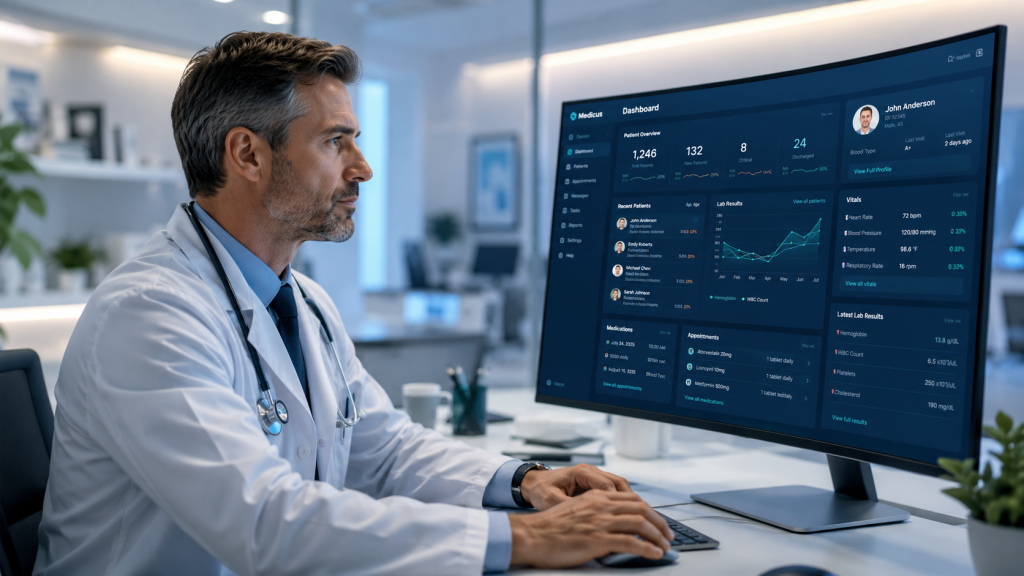
The most impactful change I have seen in clinical environments is not any single feature. It is the shift toward purpose-designed systems built around actual clinical workflows. Practices that have invested in custom medical software are reporting measurable reductions in chart review time across primary care, specialty medicine, and hospital settings. These platforms are engineered around real physician workflows rather than retrofitted billing architectures. They incorporate predictive text, smart data surfacing, automated critical value alerts, and role-specific dashboards that put the right clinical information in front of the right clinician at precisely the right moment. Working with a team experienced in custom healthcare software development in the USA means getting a system shaped around your specific patient population, specialty requirements, and documentation standards, not a generic vendor template that forces you to adapt your entire workflow to fit someone else’s assumptions.
The difference between a one-size-fits-all EHR and a purpose-built solution is the difference between a mass-produced instrument and one calibrated for a specific hand. For practices dealing with high patient volumes, complex case mixes, or multi-disciplinary teams, that calibration is not a luxury. It is what makes sustainable productivity possible.
Key Features That Separate Efficient Systems from Slow Ones
Not all medical software delivers the same results. The practices seeing the biggest time savings tend to share a consistent set of capabilities in the tools they use. When evaluating any platform, I recommend looking specifically for the following:
- Smart summarization: The system automatically surfaces the most clinically relevant data from a chart, flagging abnormal values, recent medication changes, and outstanding orders so the physician sees what matters first.
- Natural language processing (NLP): Dictated notes are transcribed and structured in real time, eliminating manual entry and after-hours catch-up documentation.
- Role-based views: A hospitalist sees a different default dashboard than an endocrinologist or nurse practitioner, reducing the volume of irrelevant data each user has to filter through.
- Integrated lab and imaging results: Results flow directly into the chart without requiring a separate login to a third-party portal.
- Mobile-responsive design: Physicians can complete chart reviews from a tablet during rounds rather than returning to a workstation between patients.
- Intelligent chart search: A single query pulls relevant history across all encounters instead of requiring the user to navigate visit by visit.
Traditional EHR vs. Custom Medical Software: A Workflow Comparison
The table below puts the key performance differences side by side, based on patterns reported across health system software assessments and practice implementation reviews.
| Feature | Traditional EHR | Custom Medical Software |
| Chart loading time | 8-15 seconds per screen | Under 3 seconds |
| Average chart review time | 18-25 minutes | 6-10 minutes |
| Customization to specialty | Limited or none | Fully configurable |
| Critical value alerts | Basic, fixed thresholds | Advanced, configurable |
| Third-party integration | Requires middleware | Built-in API connections |
| Staff training time | 20-40 hours | 4-10 hours |
The numbers tell a clear story. When clinical infrastructure is built for speed and specificity rather than general-purpose data management, the results follow.
What Physicians Are Actually Experiencing After Implementation
I have spoken with physicians in primary care, oncology, and emergency medicine who have transitioned to custom-built platforms. A consistent pattern emerges across specialties. In the first month after launch, most physicians noticed for the first time how much time they had been losing to navigation. By month three, they have restructured their pre-rounding routines. By month six, many are leaving the office earlier and reporting measurably lower end-of-day cognitive load.
Emergency medicine physicians, whose chart review demands are among the most intense in any specialty, note particular benefits from smart alert systems and auto-populated templates. Rather than entering chief complaints, vitals, and presenting history manually for every patient, the system pre-fills what it can from intake data, leaving the physician to confirm and add clinical judgment rather than transcribe logistics.
Oncologists managing large patient panels benefit from longitudinal summarization features that display trend lines across multiple visits. It becomes immediately visible whether a patient’s labs are improving, plateauing, or declining, without requiring the physician to manually compare values across separate encounter dates.
What to Look for Before You Commit to a Software Partner
If you are evaluating platforms, the American Medical Association’s Digital Medicine resources provide independent guidance on assessing clinical technology vendors. When speaking with any development team, prioritize those who conduct a workflow discovery phase before writing a single line of code. A team that asks detailed questions about your specific patient population, documentation habits, and integration requirements before quoting a solution is a team oriented toward solving your actual problem, not selling a fixed product.
Also ask for references from practices in your specialty. The challenges of a high-volume family medicine clinic differ significantly from those of a multi-site oncology group, and the software solutions that work best for each reflect that difference.
Start Reclaiming Your Time Today
Chart reviews do not have to be the part of the day every physician dreads. The combination of smarter clinical software, deliberate speed reading habits, and workflow design built around real physician needs is already helping doctors across the country reclaim hours every week. The technology exists. The implementation frameworks are proven. The only remaining variable is whether your practice is ready to make the shift.
If you are done working around an inadequate system and ready to work with one built for your specialty, explore what a dedicated custom healthcare software partner can build for your team. Schedule a discovery conversation, share your workflow pain points, and see what becomes possible when the tools finally fit the task.